by you, drawing meltwater /
to the snow,
waiting for you, to stand up /
in the flowers."
from Expectation, a poem
by Ida Gerhardt
This week, an image called
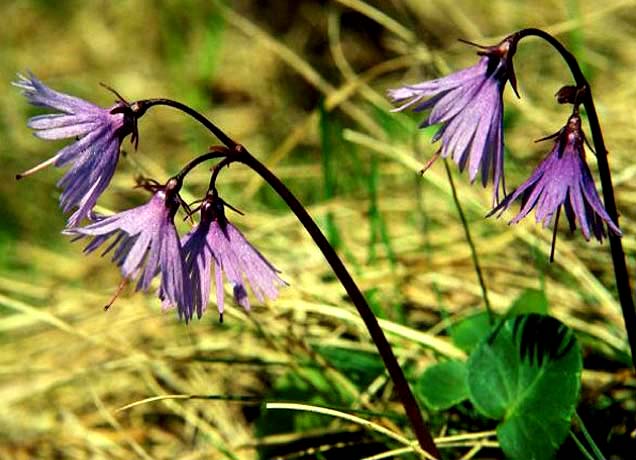
Soldanelas, Sentinels of Spring.
Also: eight new translations
of Lowland poems.
April: The World Up Close
|
|
"...All winter consumed by you, drawing meltwater / to the snow, waiting for you, to stand up / in the flowers." from Expectation, a poem by Ida Gerhardt This week, an image called Soldanelas, Sentinels of Spring. Also: eight new translations of Lowland poems. |
Acht Gedichten; Eight Poems
The guest poems for this week are new English
translations of a set of eight Dutch pieces.
The featured poets are, Ida
Gerhardt, J.B.
Charles,
Gerrit Achterberg
and Adriaan Roland
Holst.
The World Up
Close | listen
to intro in streamed
RealAudio |
One of the beautiful things that a macro lens
makes possible is that
of bringing the world of the very small up to our own scale of being.
It is in this way, much as we with time slow down a fast moving
car to make it visible, that space can be enlarged or 'blown up', as
the expression goes, so that we may consider it more closely.
Indeed, in Western thought, it could be argued that we have come
to see the whole of the world in this way—that is, as something that
can be slowed down or made larger at our convenience. And what is
more, we have by now come to believe very strongly that there
is no limit to this way of looking. The idea is that, if we continue
the process of magnification long enough, it is only a matter of time
until we reach rock bottom, so to speak, and reveal to our eyes
the basic building blocks of reality. Of course, depending on the
particular context and our point of view, this need not necessarily
be the case. For just as outerspace might go on without limit,
innerspace might do so as well. Like the proverbial philosopher's
stick, capable of being cut in half—or of being brought up twice
as close, without limit, the world of the extremely small may very
well go on without ever reaching a terminal point or conclusion.
Whatever may be the case, personally I feel more at home
pondering what I think of as the magical middle
realm of everyday
experience. And here, just a simple additional lens on a camera
can indeed reveal wonders—and lessons— to the eye. For example,
with the Alpine Soldanelas pictured above—one of the first flowers
to appear after snowmelt at about treeline—notice how we can now
with the close-up see the delicate fringe of the fused petals. (One can
however still make out the characteristic 5-pattern of the Primula
family, of which this species is a member.) And notice, too, how
the down-turning petals are complemented in form by the pointed,
recurved sepals and the long, out-reaching style with its stigma,
all highlighted in a rich darker purple. If one experiences form as
rhythm and movement in this way, it's hard to see how it would
not awaken in us a new sense of form in both music and poetry
as well. And, again, it is but a simple lens that brings this enchanting
world home to us.
In poetry, something similar takes place within the space of, for
example, the short poem. In the miniatures of contemporary poetry,
many of which were made possible by the energetic, fresh voice
which burst upon the scene with the 20th century English translations
of Chinese and Japanese classics, we frequently encounter a single
detail, a single experience, close up, as it were. (One might also note
here in this context that Dutch, as a language with a very tight
and relatively simple grammar, in contrast to German with its
highly complex inflected structures, lends itself very well to
this sparse style of expression.)
In the eight pieces I've brought together here in English
translation,
in addition to this intimate, close-up effect, there is also a remarkable
intentional incompleteness
which the reader/listener encounters.
We are given one half, or one side or part, of a situation which we
must then somehow by means of our own imagination complete
or make whole.
At the very center of the sequence of eight poems, you'll find Gerrit
Achterberg's
Telephone. It
is a haunting piece. Here, we ex-
perience, together with the poet, close up the nature of traumatic,
irreversible loss. It is remarkable that this is the very kind of emotion
that Hollywood and television try so hard—many would say
largely unsuccessfully—using every imaginable trick, to make
real for us. The poem, in contrast, makes its mark with but a single
powerful gesture: the hiss of the lost belovèd`s broken connection
becomes the timeless— and terrifyingly unchanging—sound
of eternity.
Again, the power of the image is somehow related to the fact
that Achterberg brings it up close to us, offers it to us in such
an intimate way, as it were. But in the case of the poem, in
distinction to, for example, commercial films which have by
and large become so grossly literal and explicitly realistic, we
ourselves must to do the work of bringing it to life, and thereby
make it wholly our own. I feel that's one of the things that gives
poetry its great potential depth. It is as if cinema, as it invites us on
a storylike journey as every poem or movie does, insists on making
each step and each turn for us, leaving nothing implicit. In poetry,
however, we have to do the walking ourselves. And sometimes,
something unexpected and of striking beauty -- like an ephemeral
flower of spring -- catches our eye and will have us stop and
ponder it up cose for a while.
|
Verwachting Smeltwater uit de bergen, raak mij aan: de sterren kenteren en de nieuwe maan voorzegt de lente. Winterlang verstoken van u, smeltwater aan de sneeuw ontloken, wacht ik u, om in bloemen op te staan. Ida Gerhardt (1905-1997) |
Expectation Meltwater from the mountains, touch me: the stars turning and the new moon presage spring. All winter consumed by you, drawing meltwater to the snow, waiting for you, to stand up in the flowers. |
|
De
Afwijzing Ik schrijf u met de ravenveer, Mijnheer. Mijn eer uw eer uw hart mijn hart heeft niets gemeen. Ik schrijf u met de ravenveer. Ik schrijf u met het ravenzwart het teken: neen. Ida Gerhardt |
The Rejection I write you with a raven feather, Sir. My honor and your honor your heart and my heart have nothing in common. I write you with a raven feather. I write you with raven black the sign: no. |
|
Brief In antwoord op Uw schrijven van de dato dinges kan ik U berichten ik doe reeds wat ik kan, alleen ik kan niet veel verrichten ik heb het zelf niet in de hand en wat ik doe doe ik niet goed, niet goed genoeg naar ik het kan, dus wacht U af zoals ik ook maar doe, verblivend in de hoop U hiermee te verlichten: ik doe al voor U wat ik kan. J.B. Charles (1910-1983) uit: Gedichten tot 1963 |
Letter In response to your letter of the above date I can inform you that I'm already doing what I can, only that I cannot do much I'm not myself in charge and what I do is not good enough, not good enough compared to what I could do, therefore I'll wait for your reply as I have done, remaining hopeful that I have hereby enlightened you: I'm doing everything for you that I can. |
|
Dit
Eiland Hoe zijn we hier geland, waartoe ... vanwaar ...? ligt ergens aan het strand dat vreemde schip nog klaar? en als het anker is gelicht, naar waar ... naar waar ...? Stil, sluit de deuren dicht ... bemin elkaar ... Adriaan Roland Holst (1888-1976) uit: Voorbij de wegen (1920) |
This Island How did we get here, going where ... from where ...? Is that strange ship somewhere along the beach still ready to go? and if the anchor is pulled up, where to ... where to...? Quiet, close the doors tight ... love each other ... |
|
Telefoon Geen dood ontstaat in het getal, dat mij met u verbonden heeft. Er is niets in het toestel dan het suizen van de eeuwigheid. Misschien dat zich nog eens herhaalt een oogopslag, een siddering van zijde, die nog niet verging, en dat het hoorbaar wezen zal, o teken, dat u overleeft, om zich te voegen in de ring cijfers mijner verzerkering. Gerrit Achterberg (1905-1962) |
Telephone No death manifests in the number that connected the two of us. Nothing is in the apparatus other than the hissing of eternity. Perhaps that the opening of an eye will repeat itself, a trembling of silk, that has not yet passed away, and that still wishes to be audible, o sign, that you have survived, to have found a place in the ring figures of my assurance. |
|
Klankbord Tegen de klankbord van de nacht bewegen nog uw woorden. Al wat gij hebt gezegd is blijven leven in accorden, die ik alleen in donker tref, wanneer de stilten horen, die tussen ons staan opgericht. Gerrit Achterberg |
Sounding Board Against the sounding board of the night your words still move. Everything that you have said remains alive in the sound of chords that I encounter only in darkness when the silences hear that have been put up between us. |
|
Weespraak De vogel eenzaam op het dak spreekt tot de wind om het huis: 'daarbinnen leeft een die is alleen, en toch hoorde ik dat zij sprak.' En dan spreekt de wind om het huis tot de vogel eenzaam op het dak: 'daarginder leeft een die liet haar alleen. Zij zegt het woord dat hij brak.' Ida Gerhardt (1905-1997) |
Lamentation The bird so lonely on the roof speaks to the wind about the house: "inside lives one who is alone, and yet I heard that she spoke."
And then the wind about the house speaks |
|
De
Gestorvene Zeven maal om de aarde te gaan, als het zou moeten op handen en voeten; zeven maal, om die éne te groeten die daar lachend te wachten zou staan. Zeven maal om de aarde te gaan. Zeven maal over de zeeën te gaan, schraal in de kleren, wat zou het mij deren, kon ik uit de dood ik die éne doen keren. Zeven maal over de zeeën te gaan- zeven maal, om met zijn tweeën te staan. Ida Gerhardt (1905-1997) |
The Departed One To go seven times around the earth, if necessary on hands and feet; seven times, to greet the one who would be waiting with a smile. To go seven times around the earth. To go seven times over the seas, threadbare clothes, makes no difference to me, could I bring back that one from the dead. To go seven times over the seas, seven times, to stand as two together. (all tr. Cliff Crego) |
| view / print Picture/Poem
Poster: Meltwater (Ida Gerhardt) (86 K) | or
download as PDF |
|
See also: new |

|
"Straight
roads, Slow rivers, Deep clay." |
A collection of contemporary Dutch poetry in English translation, with commentary and photographs by Cliff Crego |
|
See also another website by Cliff Crego: The Poetry of Rainer Maria Rilke |
A presentation of 80 of the best poems of Rilke in both German and new English translations: biography, links, posters |